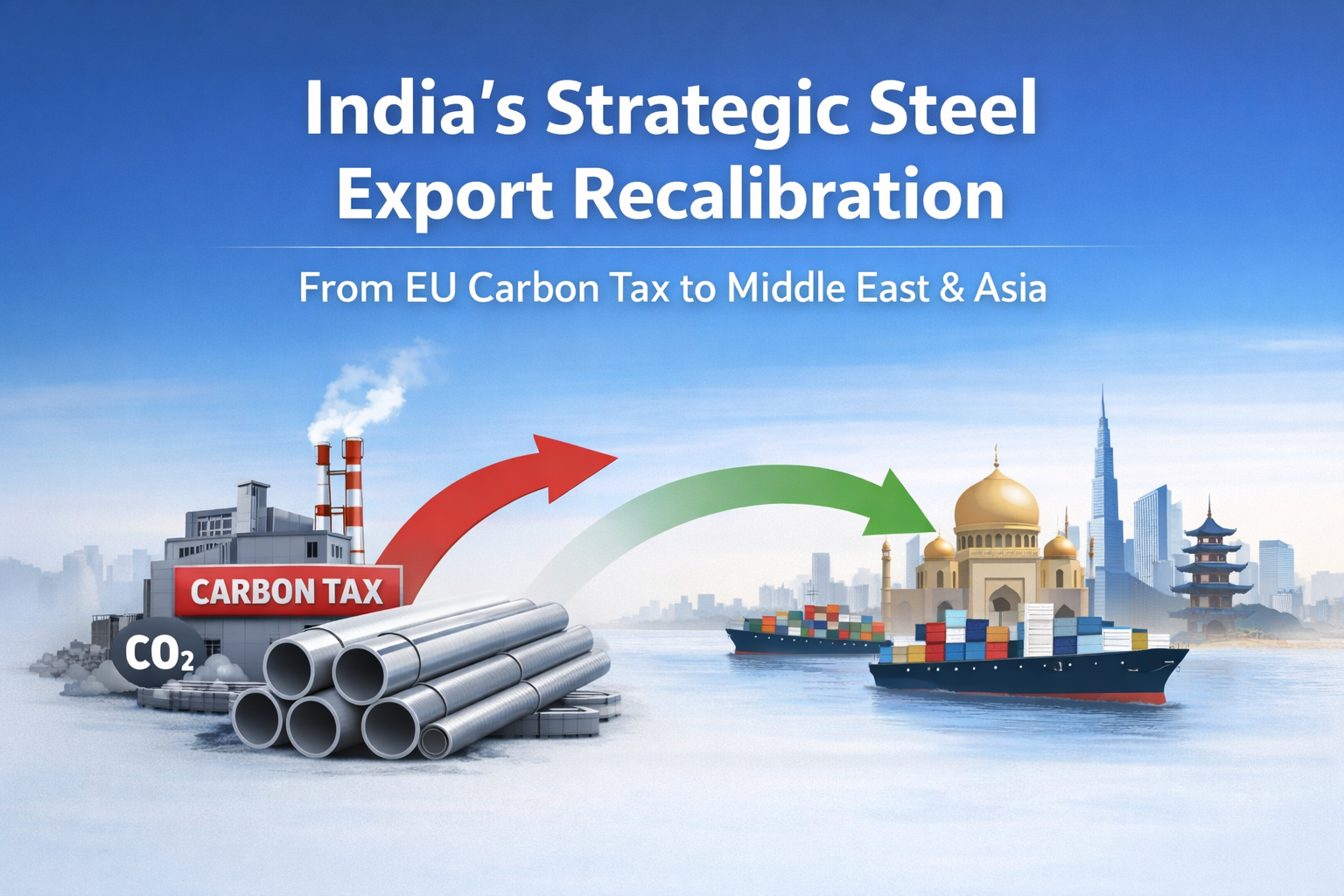
1. EU Carbon Border Mechanism Reshapes Steel Trade Dynamics
The global steel trade landscape has entered a new phase following the implementation of the European Union’s Carbon Border Adjustment Mechanism (CBAM) in January 2026. The policy effectively imposes a carbon-linked cost on imports of emission-intensive products such as steel, aligning them with the carbon pricing regime applicable to domestic European producers.
For India, this shift is significant. The European Union has historically been a major destination for Indian finished steel exports. The introduction of carbon-linked pricing now alters cost competitiveness, compliance requirements, and long-term export viability for Indian mills operating through relatively carbon-intensive production routes.
This development marks a structural change rather than a temporary disruption. Environmental regulation has now become a decisive trade variable.
Analytical Insight
CBAM is not merely a tax. It signals the beginning of climate-adjusted global trade flows. Countries with higher emission intensity in steelmaking will increasingly face market access constraints in advanced economies.
2. Direct Impact on Indian Steel Exporters
Under CBAM, importers into the EU must purchase carbon certificates reflecting the embedded emissions of imported steel. This creates three immediate challenges for Indian exporters:
- Increased landed cost of Indian steel in European markets
- Pressure on margins where exporters absorb part of the carbon cost
- Mandatory emissions reporting and verification compliance
Indian steel production still relies significantly on blast furnace-basic oxygen furnace routes that are more carbon-intensive compared to electric arc furnace routes used widely in Europe. This structural difference translates into a competitiveness gap under carbon pricing regimes.
In addition, the administrative compliance burden may disproportionately affect smaller exporters lacking established carbon accounting systems.
Analytical Insight
The competitiveness shift will not be uniform across Indian producers. Integrated steelmakers with stronger ESG frameworks and lower emission intensity may adapt faster, while high-emission producers risk market share erosion.
3. Strategic Export Diversification Toward Middle East and Asia
In response to emerging headwinds in the EU market, India is actively recalibrating its steel export strategy toward high-growth regions in the Middle East and Asia.
These regions present strong demand fundamentals driven by:
- Large-scale infrastructure projects
- Urbanization and industrial expansion
- Oil-funded construction cycles in Gulf economies
- Manufacturing growth in Southeast Asia
The Middle East, in particular, remains a steel-intensive growth corridor due to ongoing mega infrastructure and real estate development. Similarly, Southeast Asian economies continue expanding construction and manufacturing capacities.
India’s export pivot is therefore not reactive alone; it is also opportunity-driven.
Analytical Insight
Diversification reduces regulatory concentration risk. A broader export basket across emerging markets can stabilize volumes while reducing dependence on carbon-regulated economies.
4. Parallel Focus: Securing Raw Material Supply Chains
Export strategy cannot be separated from input security. India remains heavily dependent on imported coking coal, with a significant portion sourced from Australia. Any cost pressure on exports makes raw material optimization even more critical.
To strengthen supply resilience, Indian players are exploring:
- Long-term offtake agreements
- Strategic asset acquisitions abroad
- Diversified sourcing beyond traditional suppliers
Securing stable input flows is essential not only for cost control but also for maintaining export competitiveness in new markets.
Analytical Insight
Trade diversification and raw material security form a dual strategy. One protects the revenue side, the other safeguards the cost structure.
5. Decarbonization as the Long-Term Competitive Lever
While CBAM presents immediate challenges, it also accelerates the inevitable transition toward low-carbon steelmaking.
Future competitiveness will depend on:
- Expansion of electric arc furnace capacity
- Increased use of scrap
- Green hydrogen-based direct reduced iron initiatives
- Renewable energy integration in steel production
Indian producers that proactively invest in emission reduction technologies will not only regain competitiveness in the EU but may also gain premium positioning in global green steel supply chains.
Analytical Insight
Carbon compliance will evolve from a regulatory obligation into a branding and pricing advantage. Early movers will capture long-term value.
6. Structural Realignment of India’s Steel Trade
The CBAM-triggered pivot represents more than a market shift. It reflects the integration of climate policy into global trade architecture.
India’s steel industry now stands at a strategic crossroads:
- Adapt production pathways
- Diversify export destinations
- Strengthen raw material security
- Invest in decarbonization
The outcome of this transition will determine India’s positioning in the next decade of global steel trade.
Data Snapshot: India Steel Export & Input Dependency Trends
| Indicator | Status / Trend |
|---|---|
| EU share in Indian steel exports (historical) | Significant export concentration |
| Coking coal import dependency | Very high reliance on imports |
| Key new target markets | Middle East, Southeast Asia |
| Strategic response | Diversification + decarbonization + supply security |
Disclaimer: industry reports, policy documents, European Commission briefings on CBAM, and recent media coverage on India’s export diversification strategy.
Disclaimer: Data and insights presented in this article are compiled from publicly available government and industry sources including NITI Aayog, ICRA, CRU, World Bank, and others. Markintel has independently analyzed and interpreted this information for research and educational purposes; it does not represent the official views of any cited organization.