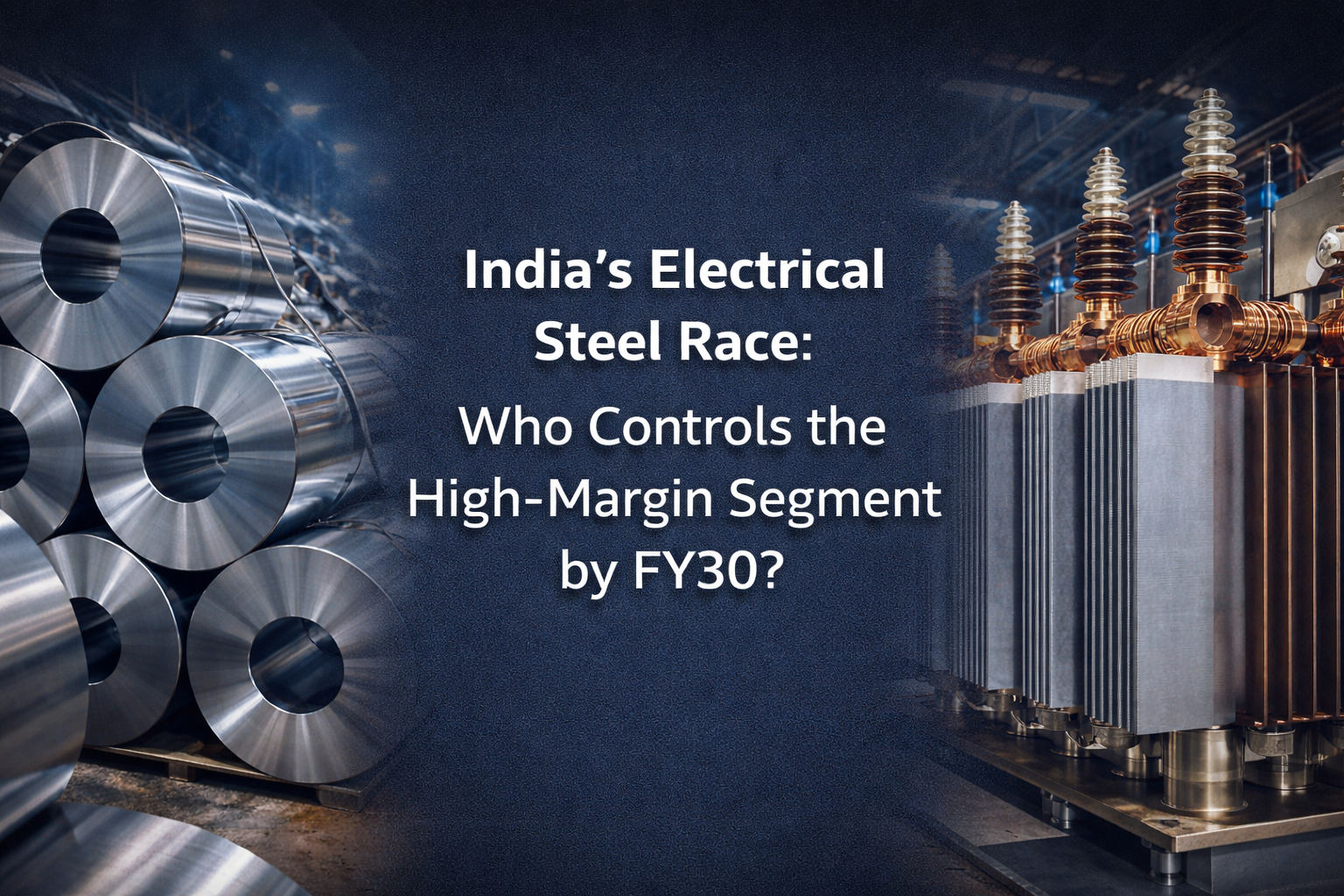
India’s electrical steel market is entering a decisive phase of capacity realignment and import substitution. While the segment accounts for less than 3 percent of India’s total steel consumption by volume, it carries disproportionately higher strategic and margin significance. The race underway is not about tonnage expansion alone, but about technological control, customer validation, and long term earnings quality.
Market Size and Demand Structure
India’s total electrical steel demand is currently estimated at 2.8 to 3.2 million tonnes annually, divided broadly into:
- CRGO (Cold Rolled Grain Oriented): 1.2 to 1.5 million tonnes
- CRNO (Cold Rolled Non Grain Oriented): 1.5 to 1.7 million tonnes
CRGO is primarily used in power and distribution transformers where magnetic flux directionality reduces core losses. CRNO is used in motors, compressors, industrial drives, and increasingly in electric vehicle traction systems.
Demand growth in CRGO is closely linked to India’s transmission and renewable expansion plans. With a national target of 500 GW renewable capacity by 2030, transformer intensity across substations and grid corridors is expected to rise steadily. CRGO demand is projected to grow at 7 to 9 percent CAGR, potentially reaching 1.8 to 2.0 million tonnes annually by FY30.
CRNO demand, supported by industrial automation and EV penetration, is expected to grow at 6 to 8 percent CAGR, which could push total CRNO demand beyond 2.2 to 2.5 million tonnes by FY30.
Combined electrical steel demand could therefore exceed 4 million tonnes annually within five years, making domestic capacity expansion strategically critical.
Import Dependence and Supply Vulnerability
India has historically depended on imports for over 70 percent of CRGO demand. Major supplying countries include Japan, South Korea, China and parts of Europe. This dependence has exposed transformer OEMs to price pass through risk, long procurement cycles, and foreign exchange volatility.
CRNO import dependence is lower but remains meaningful in high efficiency grades used in EV motors and premium industrial applications.
Electrical steel typically commands a 20 to 35 percent premium over hot rolled coil, with CRGO often delivering materially higher EBITDA per tonne than commodity flat steel. Therefore, reducing import dependence is not merely about supply security but also about retaining margin within the domestic steel ecosystem.
Announced Capacity Expansions
The most significant recent expansion in CRGO has been announced by JSW Steel in collaboration with JFE Steel. Declared capacity increases include:
- Nashik CRGO expansion from 50,000 tonnes per annum to 250,000 tonnes
- Vijayanagar expansion from 62,000 tonnes to 100,000 tonnes
The incremental addition of approximately 238,000 tonnes annually represents a meaningful domestic scaling step. However, even at full ramp up, this would address only about 15 to 18 percent of current CRGO demand.
Assuming demand rises toward 2 million tonnes by FY30, domestic supply would still leave a structural gap unless additional integrated producers commit to multi hundred thousand tonne expansions.
This suggests that while import dependence may decline from historic highs, it is unlikely to disappear entirely in the medium term.
Technology Barriers and Qualification Cycles
Electrical steel manufacturing is materially more complex than commodity flat steel production. CRGO production requires precise grain orientation control, silicon chemistry management, decarburisation annealing, and advanced finishing processes such as laser scribing to reduce core loss.
Transformer OEM approval cycles typically extend 12 to 24 months, requiring consistent magnetic performance validation. As a result, commissioning capacity does not immediately translate into commercial market share. Quality consistency and long term supplier relationships are decisive.
Technology partnerships reduce execution risk. Players lacking established technical collaborations face longer ramp up periods and higher risk of product rejection during qualification.
This creates a natural advantage for early movers with credible technical alliances.
Competitive Positioning
JSW Steel currently appears best positioned to scale CRGO meaningfully due to its declared expansions and technology collaboration with JFE. Other integrated producers have indicated interest in specialty and electrical steel but have not yet announced comparable scale additions in CRGO.
In CRNO, competition is broader, but high efficiency motor grade steels still require process discipline and metallurgical control. As EV adoption accelerates, the share of premium CRNO grades is expected to increase.
The segment therefore favors technologically capable integrated producers over smaller secondary players.
Margin and Strategic Implications
Electrical steel’s higher realisation and relatively stable demand profile offer steelmakers an opportunity to improve blended EBITDA resilience. Increasing electrical steel share from negligible levels to even 5 to 7 percent of product mix can meaningfully enhance earnings quality.
Unlike commodity flat steel, which remains exposed to global oversupply cycles and dumping pressures, electrical steel is tied to domestic infrastructure and industrial growth.
For investors and strategic stakeholders, the key question is not simply who adds capacity, but who successfully qualifies product, secures OEM contracts, and scales utilisation without quality compromise.
Conclusion
India’s electrical steel race is entering a structurally important phase. Demand growth through FY30 is visible and policy supported. Import substitution is progressing but remains incomplete. Technology depth, execution discipline and OEM validation capability will determine leadership.
By FY30, control over CRGO and premium CRNO capacity is likely to become one of the most significant differentiators in earnings quality among Indian steel producers.